A redemption starts when the customer views a wallet balance or applies points to a cart. It ends when the hold is confirmed by an order-placed event or reverted after the allowed window.
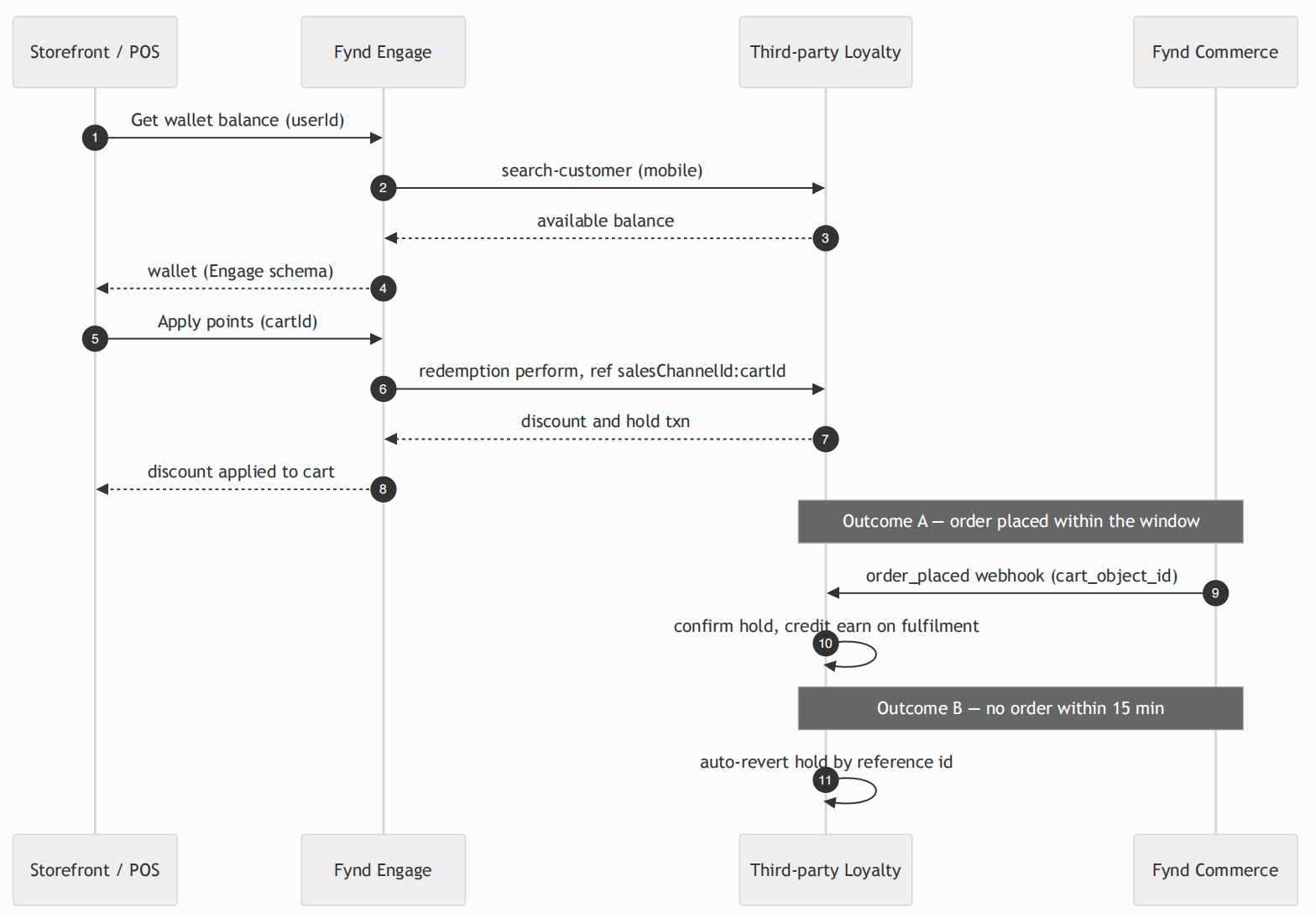
- Get the wallet balance: The storefront or POS requests the wallet balance using the Engage user ID.
- Resolve the customer: Engage calls the partner customer-search operation using the customer's mobile number.
- Return the available balance: The partner returns the current available balance.
- Map the wallet: Engage maps the provider response into the Engage wallet schema.
- Apply points: The storefront or POS applies points using the cart ID.
- Create the hold: Engage calls the provider redemption operation with
action:performand reference<salesChannelId>:<cartId>. - Return the discount: The provider returns the discount and hold transaction.
- Apply the discount: Engage returns the mapped discount to the storefront or POS.
When Fynd Commerce emits the matching order-placed webhook within the allowed window, the partner confirms the hold using order.cart_info.cart_object_id to resolve the cart reference.
The order-placed event confirms the redemption. Earned points are credited later, after the applicable shipment reaches a terminal delivery status.
Engage exposes POST /v2/order/transaction/cancel, which maps to the partner cancelOrder adapter method. The provider reverts the hold with action:revert using the original redemption reference.
The order-placed event confirms the points spent by the customer. Earned points are credited only when a shipment reaches delivery_done or handed_over_to_customer. When a shipment is cancelled or a refund is initiated, reverse points against that shipment's loyalty_discount value
- Treat
<salesChannelId>:<cartId>as the unique redemption reference. - Support perform, confirm, and revert operations against the same reference.
- Return a consistent result when an event or request is retried.
- Prevent a confirmed hold from being reverted by the timeout job.
Continue to Webhooks for event names, payload fields, and shipment status actions.